

Table of Contents
- Two Fundamental Categories: Attar and Ruh
- The Still: Deg, Bhapka, and Living Fire
- Sandalwood: The Foundation of Everything
- The Sacred Flowers
- The Earthy and the Green
- The Leather Kuppi: Where Time Completes the Work
- The Three Great Composite Attars
- The Seasonal Logic
- The Cross-Cultural Tapestry
- A Note on Synthetics and Authenticity
- Approaching These Materials
What these extraordinary fragrant materials are, how they are made, and why they are unlike anything else in the world
If your experience of fragrance has been shaped by European and Western traditions, the world of oriental and Indian perfumery will present something genuinely unfamiliar. This is not simply a different selection of ingredients arranged in similar ways. It is an entirely different philosophy of how fragrance is created, carried, and worn. The materials are different. The methods are different. The results are unlike anything modern synthetic perfumery can achieve.
At Fraterworks, we draw deeply from this tradition. This guide is intended to walk you through the key materials — what they are, what they smell like, how they are produced, and how they relate to one another — so that you can approach them with understanding and confidence.
Two Fundamental Categories: Attar and Ruh
Before examining individual materials, it is essential to understand the two broad categories of Indian fragrant oils, because the distinction between them shapes everything that follows.
An attar (also spelled itr or ittar) is a natural perfume oil produced through hydro-distillation into a base of sandalwood oil. The flowers, roots, or botanicals are placed in a copper still with water, heated gently, and the resulting aromatic vapour is captured directly within sandalwood oil sitting in the receiver vessel. Because sandalwood is an exceptional fixative, it absorbs and preserves even the most delicate aromatic fractions — volatile elements that would be lost in a modern condenser. The result is an alcohol-free perfume of remarkable longevity and depth. A single drop of a well-made attar can last an entire day on skin, unfolding slowly through shifting layers without the sharp alcohol opening of a Western spray fragrance.
A ruh (literally "spirit" or "soul" in Hindi) is the pure hydro-distilled essential oil of a plant, extracted without a sandalwood base. Where an attar is always a marriage of the source material and sandalwood, a ruh stands alone — the unmediated essence of the plant itself. Ruhs tend to be more concentrated and direct in character, and they are often used as components within composite blends rather than worn in isolation, though some, like Ruh Khus, are magnificent on their own.
This distinction matters. When you encounter "Rose Attar," you are meeting a fusion of rose and sandalwood. When you encounter "Ruh Gulab," you are meeting the rose alone.
The Still: Deg, Bhapka, and Living Fire
The apparatus used to create these materials has remained essentially unchanged for centuries. It consists of three parts: a copper cauldron called the deg, which holds water and the fragrant material; a hollow bamboo pipe called the chonga, wrapped in twine for insulation; and a copper receiver called the bhapka (from bhap, meaning steam — literally, "the vessel that captures the steam").
The deg sits within a brick-and-clay enclosure and is heated from below by a fire of wood or dried cow dung. The heat must be carefully moderated — an even, steady fire ensures that delicate aromatic molecules are gently vaporised rather than destroyed. Skilled craftsmen tend the fires continuously, and every joint is sealed airtight with cotton and clay so that no precious vapour escapes.
The bhapka contains approximately five kilograms of sandalwood oil and sits partially submerged in a cooling tank of water, serving as both condenser and receiver. The craftsmen judge progress by feeling the warmth and subtle vibration of the receiver beneath the water — without any modern instrumentation.
After the first four hours, the receiver is replaced with a fresh one, and distillation continues for another six hours. This entire process may be repeated as many as fifteen times, each cycle enriching the sandalwood base further. The greater the number of repetitions, the more concentrated and valuable the attar becomes.
Sandalwood: The Foundation of Everything
It is impossible to discuss Indian perfumery without understanding sandalwood (Santalum album), because in the attar tradition it is not merely a carrier or diluent. It is the absorptive matrix into which every aromatic fraction is drawn. It transforms, integrates, softens, and elevates all components. Without high-quality sandalwood oil, the entire tradition collapses.
The sandalwood tree is a small evergreen that reaches forty to fifty feet at maturity. The valuable portion lies concealed within its core: the scented heartwood. This heartwood begins forming only after approximately ten years of growth and reaches optimal development between fifty and sixty years of age. The finest heartwood develops in the dry, rocky, hilly terrain of Tamil Nadu, Karnataka, and Kerala — the region long known as the "sandalwood belt."
Sandalwood is a hemi-parasite, attaching to the roots of neighbouring plants through specialised structures called haustoria and drawing nutrients from them. Even today, the precise ecological balance required for optimal growth remains imperfectly understood. Despite concerted efforts at modern cultivation, survival rates have often been disappointing.
The first inhalation of true sandalwood oil has a way of imprinting itself upon memory. It does not strike sharply. Instead, it enters gently and settles deeply — creamy, warm, woody, with a softness that is both intimate and expansive. There is nothing quite like it, and no synthetic substitute has yet captured its character fully.
The Sacred Flowers
Indian perfumery draws upon a remarkable palette of flowers and botanicals, many of which are largely unknown in the West. Each produces a distinct aromatic character, and each has its own traditions of harvest, distillation, and use.
Rose (Gulab)
The rose holds a position of unmatched reverence in Indian culture. It is not merely admired; it is given — placed before deities, woven into garlands, scattered upon shrines, and exchanged as gestures of welcome and blessing. Across India, garland makers thread roses into malas that will be offered in temples throughout the day.
Kewda (Pandanus)
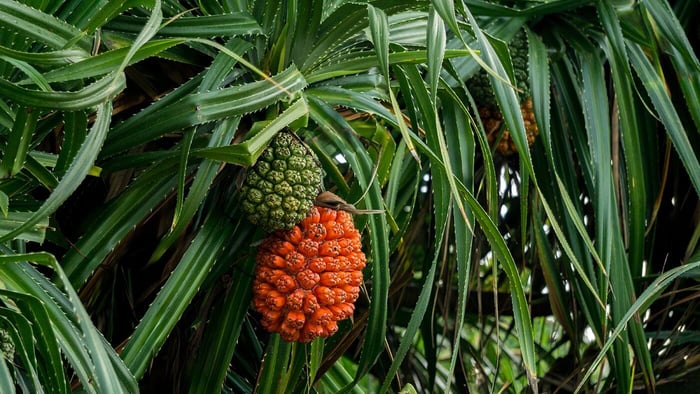
The kewda flower, from the screwpine tree (Pandanus odoratissimus) of Orissa's Ganjam district, produces one of the most distinctive and powerfully fragrant materials in the Indian tradition. Only the male inflorescences produce fragrance — the Mughal emperor Babur described it in 1525 as possessing a quality of "moist musk."
The scent is intensely sweet, diffusive, honeyed, and luminous, with a humid tropical depth that is entirely unique. There is nothing in Western perfumery that closely resembles it. Concentration is measured by flower count — a "ten-thousand-flower" kewda attar is more concentrated than a "five-thousand-flower" — and approximately one thousand flowers yield a single ounce of Ruh Kewda. Three grades of distillate are recognised: Agari (the first and finest), Pichari (second), and Tigari (third).
Synthetic kewda exists, but it is flat and linear compared to the authentic material, which breathes and evolves on skin. The principal aromatic molecule, methyl ether of beta-phenylethyl alcohol, constitutes sixty to eighty per cent of the natural oil, but the remaining minor constituents make all the difference.
Golden Champa (Michelia champaca)
The golden champa is sacred in Indian tradition. The tree itself is magnificent — a tall pyramidal form reaching sixty to a hundred feet, with glossy deep green leaves — and the golden-orange flowers it produces are among the most aromatically complex in the natural world.
The fragrance is warm, diffusive, and richly layered, with facets of orange flower, ylang-ylang, and tea rose, underpinned by a spiced warmth. As a champa attar unfolds on skin, it moves from a luminous floral brightness through a tea-like middle phase and settles into the sandalwood base. The final attar contains approximately three per cent champa essence — the remainder is sandalwood — yet the personality of the flower remains vividly present. Distillation takes roughly fifteen days.
Parijata (Night Jasmine)
Parijata (Nyctanthes arbor-tristis), also known as "night jasmine" or "the fallen star," is one of the most poetic materials in the Indian palette. The flowers bloom only at night and fall from their branches before dawn — white petals surrounding a vivid orange tubular centre.
The fragrance calls to mind orange blossom touched by jasmine: sweet without heaviness, luminous, and quietly persistent. Parijata attar is never loud. Its beauty lies in restraint. The distillation into sandalwood is repeated for fifteen or more days, and the orange centres of the fallen flowers are separately dried and used as a saffron-like dye by monks.
Kadamba
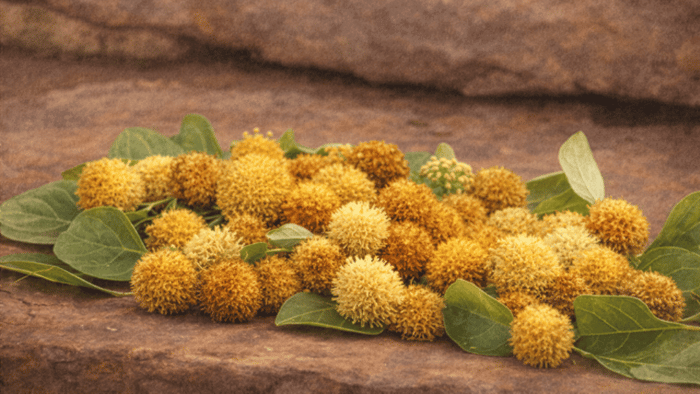
The kadamba tree (Anthocephalus cadamba) produces golden globe-shaped flowers during August and September, associated in Indian devotional culture with Krishna — the flowers are sometimes called "Krishna laddus." The fragrance is woody-floral with a distinctive minty, borneolic top note that softens into a sweet-floral dryout reminiscent of both champa and neroli.
Kadamba is among the rarest materials in the attar tradition. The oil yield for a pure ruh is staggeringly low: approximately 0.008 per cent, meaning nearly twelve and a half thousand kilograms of flowers are needed to produce a single kilogram of oil. As an attar, approximately eighty kilograms of flowers are distilled daily into the sandalwood base over a period of fifteen days.
Marigold (Genda)
The humble marigold (Tagetes erecta) is ubiquitous in Indian temples and celebrations — abundant, resilient, and tolerant of heat. Its aromatic character is quite different from the sweeter florals: vegetal, solar, slightly bitter, green, and sharp. It serves as a counterpoint within the broader palette, contributing brightness and a certain earthy frankness. Ninety to a hundred and twenty pounds of flowers fill each still charge, and distillation proceeds over many days into sandalwood.
The Earthy and the Green
Ruh Khus: Oil of Tranquillity
One of the most prized products of Indian distillation is Ruh Khus — the pure essential oil of wild vetiver (Chrysopogon zizanioides). This is emphatically a ruh, not an attar: the oil is distilled without any sandalwood intermediary, and it stands as one of the great aromatic materials of the world.
Wild Indian vetiver is distinct from the cultivated vetiver of Haiti, Java, or Réunion. The North Indian variety is seed-propagating and grows wild across Rajasthan, Uttar Pradesh, Haryana, and Madhya Pradesh. It commands roughly four times the price of cultivated vetiver within India, and over one hundred and fifty aromatic molecules have been identified within it.
The roots are chopped, soaked for ten to twelve hours, and then distilled for twelve to twenty-four hours. The resulting oil is dark, thick, brown, almost syrup-like in consistency. The scent is one of powerful earthy diffusion: freshly turned soil, forest floor after rain, with subtle sweetness and woody nuances emerging over time.
In Ayurvedic and Unani tradition, vetiver is classified as sheetal — cooling. This is not merely metaphorical. During the Mughal period, woven vetiver root screens called tattis were hung in doorways and windows and kept damp; as air passed through them, it was cooled and scented simultaneously. Khus sharbat, a summer beverage made from vetiver root infusion, remains popular across northern India. As a perfume material, Ruh Khus belongs to warm weather — bringing grounded, cooling freshness to the skin.
Mitti Attar: The Fragrance of the Earth
Perhaps no single material better illustrates the poetic ambition of Indian perfumery than mitti attar — literally "the fragrance of the earth." This extraordinary attar captures the scent of baked earth receiving the first monsoon rains: that unmistakable smell known in the West as petrichor.
To produce mitti attar, specially prepared clay discs from the region around Kannauj are baked and then distilled into sandalwood oil. The compound geosmin, produced by soil-dwelling bacteria, is among the key aromatic molecules captured. The result is a perfume that genuinely smells of rain-soaked earth — cool mineral freshness combined with the warmth and depth of sandalwood. It is one of the most evocative and unusual materials available to the perfumer, and entirely unique to the Indian tradition.
The Leather Kuppi: Where Time Completes the Work
Once distillation is complete, attars are poured into leather bottles called kuppi for storage and ageing. This is not merely decorative tradition. Camel leather, properly treated, is microscopically porous. After distillation, attars carry residual moisture — subtle traces of water suspended within the oil. In glass, this moisture lingers. In metal, it stagnates. But within leather, it slowly dissipates. The oil concentrates. The notes settle. Harshness softens.
Ageing in the kuppi is an active stage of perfumery, not passive storage. The perfumer collaborates with time. Sandalwood attars, rose attars, composite attars — all require patience not only in distillation but in containment. Some of the finest composites reveal their full character only after years.
The Three Great Composite Attars
Beyond the single-flower attars and ruhs, the Indian tradition reaches its most extraordinary heights in the composite attars — elaborate blends of numerous botanicals distilled in carefully sequenced stages. Three composites stand as the pillars of the tradition, and understanding them provides a framework for the entire aromatic landscape.
Majmua: The Cooling Blend
Majmua (from the Arabic majmua, meaning "collection" or "assembly") is the great cooling composite. Classified within the Unani medicinal framework as Thandak — cooling in nature — Majmua is traditionally worn during the hot summer months.
Its composition typically draws upon Ruh Khus (wild vetiver), kewda attar, mitti attar, and kadamba attar, among other cooling materials. The overall character is fresh, earthy, green, and gently floral — a fragrance that feels like shade on a hot day. Where single attars express one voice, Majmua weaves several cooling voices into a coherent whole.
Shamama: The Warming Crown
Shamama is perhaps the most extraordinary achievement of the Indian perfumer's art. It is a warming composite, classified as Garmi (heating) in Unani tradition and traditionally worn in the cooler months. Where Majmua cools, Shamama envelops.
A Shamama may contain between twenty and forty-five or more individual fragrant materials, assembled in carefully sequenced phases over a period of weeks or even a full month. The construction follows a rigorous architectural logic.
It begins with the skeletal frame: lichens such as charila (Himalayan lichen) are distilled into sandalwood over several days, providing mineral-woody dryness and exceptional fixative capacity. Next comes the roasted root phase — spikenard, valerian, cyperus (nagarmotha), and galangal are lightly roasted, ground, and distilled into the already lichen-charged base. The roasting alters their character, coaxing warmth and a faint animalic quality that creates what might be described as a botanical musk register.
The spice and seed phase follows: cinnamon, clove, cardamom, nutmeg, mace, ambrette seed, and patchouli are distilled into the matrix, introducing radiance within density. Parallel to these distillations, pyro-alchemical preparations may be added: choya ral (burnt shell distilled into sandalwood) introduces a mineral-smoky undertone, whilst choya loban (benzoin pyro-distillate) adds balsamic warmth.
Only after all these saturations does the composition enter its most intimate stage. Selected floral attars — rose, jasmine, champa, or keora — along with saffron softened in rose water are blended into the charged base. The mixture is sealed and subjected to gentle, sustained warmth. This is not further distillation but integration: under controlled heat, the disparate layers marry.
Finally, transferred into leather kuppi, the perfume continues its inward transformation. Months soften edges; years deepen coherence. In well-made Shamama, full maturity may reveal itself only after five years or more.
Darbar: The Regal Composite
Darbar (meaning "royal court") occupies the space of formal magnificence. Where Shamama is intimate and enveloping, Darbar is outward and opulent. Its emphasis falls upon the floral crown — rose and jasmine feature prominently — supported by animalic and resinous bases that give it projection and presence. If Shamama is the fragrance of a winter evening by firelight, Darbar is the fragrance of ceremony and occasion.
How They Relate
These three composites are not isolated creations but form an interconnected system. Related forms — Hina, which preserves a pronounced skeletal backbone with mineral dryness and ceremonial clarity, and Amberi, which emphasises balsamic and resinous glow — share the same fundamental architectural method but shift the structural emphasis. Each producing family interprets these forms according to its own lineage, guarding its particular recipe closely.
The Seasonal Logic
Traditional attar culture did not separate fragrance from the broader context of health and season. Within the frameworks of Unani and Ayurvedic medicine, substances are evaluated according to thermal and qualitative tendencies — Thandak (cooling) and Garmi (warming).
Light florals, cooling vetiver, and mitti attar belong to summer daylight. Warming composites like Shamama, rich with roasted roots, dense spices, and saffron, belong to winter evenings. This is not arbitrary fashion but reflects a coherent understanding of fragrance as something that interacts with the body and its environment.
Restraint remains central. A single drop suffices. The dignity of these fragrances lies in their subtle field rather than in assertive diffusion. They are worn close to the skin and discovered by those near enough to notice.
The Cross-Cultural Tapestry
The composite attars of India did not arise in isolation. They represent a remarkable synthesis of traditions. When Persian and Arab refinements in distillation science moved eastward, they met a land already rich in botanical abundance. The science of extracting volatile fractions from rose, resin, and spice encountered forests of sandalwood, hills of lichen, and markets heavy with cinnamon and cardamom.
In Persian courts, musk and ambergris were symbols of cultivated sovereignty. When the Mughal imagination took root in Hindustan, it carried this sensibility with it, yet it did not merely replicate Persian fragrance culture. It absorbed Indian materials, Indian heat, Indian soil. Composite attars such as Hina and Shamama were born in this meeting — reflecting Persian refinement in their architectural structure whilst being unmistakably Indian in material density.
A Note on Synthetics and Authenticity
Throughout this guide, we have described materials that are entirely natural, produced by methods that have remained fundamentally unchanged for centuries. It is worth noting that synthetic versions of many of these materials exist, and they are often marketed under the same names. The difference is not subtle. Synthetic kewda is flat and linear where the authentic material breathes and evolves. Synthetic sandalwood lacks the creamy depth and slow-building warmth of the real oil. Synthetic musk bears little resemblance to the botanical musk illusion created by roasted roots in a well-made Shamama.
The materials described here are expensive because they are the products of extraordinary patience, skill, and natural abundance. They cannot be rushed, and they cannot be faked convincingly.
Approaching These Materials
If you are new to oriental and Indian perfumery, a few practical suggestions may be helpful.
Begin with a single-flower attar — rose or champa — to understand the fundamental character of an attar: how the sandalwood base carries and reveals the floral essence over hours, how the fragrance changes on your skin through the day, and how different it feels from an alcohol-based perfume.
Then explore a ruh — Ruh Khus is an ideal starting point — to understand what a pure Indian essential oil offers without the sandalwood intermediary.
From there, approach the composites. Majmua will introduce you to the cooling tradition; Shamama to the warming. Pay attention to when you wear them — time of day, season, setting — and you will begin to feel the seasonal logic that has governed this tradition for centuries.
Apply sparingly. A single drop on the inner wrist or behind the ear is sufficient. Allow the fragrance to come to you rather than projecting it outward. These are intimate materials, and their beauty rewards patience and proximity.
This article draws upon the extensive research and field work of Christopher McMahon, retired from White Lotus Aromatics, whose personal explorations of the Indian attar tradition and aromatic culture have provided an invaluable record of this extraordinary heritage.