
Table of Contents
Golden spheres in monsoon air,
Rain-washed light in clustered bloom;
Bees hum low in nectar-sweet prayer,
Earth made fragrant in the womb of cloud.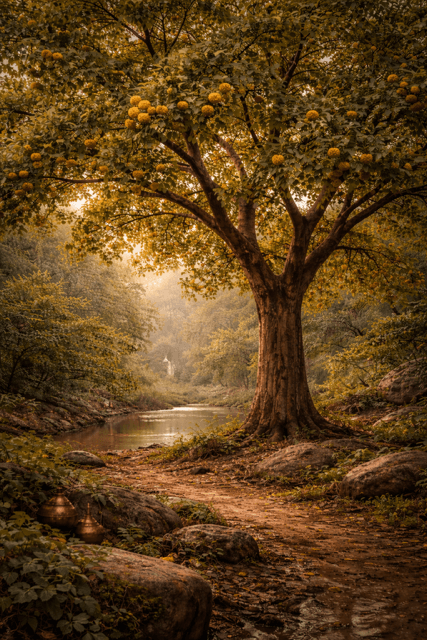
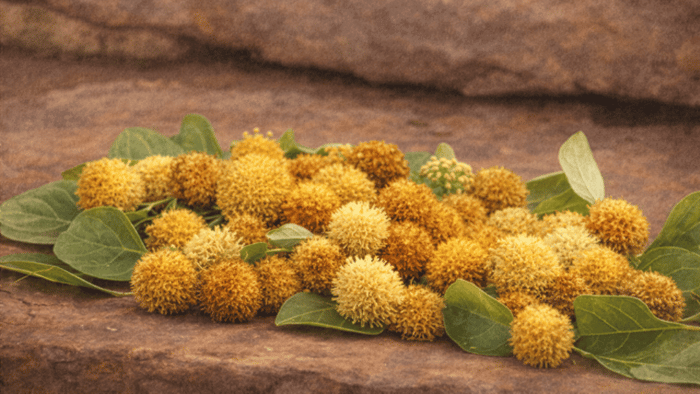
The Kadamba tree of India (Anthocephalus cadamba) is a tall, sturdy tree with a straight bole from which many horizontal branches extend. Its glossy, deep-veined leaves are ovate-oblong with sharply pointed tips. In the months of August and September, its sweetly aromatic, golden-yellow globular flowers grace the branches, presenting a vision of uncommon beauty. To inhale the rich fragrance of these blossoms while contemplating the form of this magnificent tree is a rare privilege. If one has the good fortune to absorb oneself in such an experience, it becomes easy to understand why this tree holds a special place in the hearts of the Indian people.
I first encountered this botanical treasure in an unexpected location — in the desert of Rajasthan near Jodhpur. Generally speaking, Kadamba trees prefer warm, humid climates where they are nourished by an abundance of monsoon rain.
"It (Kadamba) is found in the sub-Himalayan tract from Nepal eastwards, on the lower hills of the Darjeeling Terai in West Bengal where it is common; in Chota Nagpur (Bihar), Orissa and Andhra Pradesh; in Karnataka and Kerala on the West Coast; and in the Western Ghats. In the Andamans (islands off the east coast of India), it is very common in damp places along large streams." (Wealth of India, Volume 1, page 305)So discovering this tree in a desert ravine outside the city limits was quite a unique experience.
Cadamba Attar

$27.50
The cadamba tree produces golden globe-shaped blossoms during the Indian monsoon season — round, spiky, and intensely fragrant. These are gathered at dawn and distilled into sandalwood oil over about fifteen days, with fresh flowers added daily. The yield is… read more
A Journey to Rajasthan
Our visit to Rajasthan, just at the advent of the monsoon season in July 1996, was marked by a number of unique aromatic adventures, but the discovery of the Kadamba trees was perhaps the most surprising. Ramakant Harlalka, the man who has been instrumental in teaching me about India's aromatic traditions, and I commenced our fragrant expedition in Delhi. He had journeyed there from Bombay, where he lives, and I flew in from California.
We had made several prior tours of India to gather knowledge about aromatic plants, their role in the cultural life of the people, as well as their use in the modern domestic and international fragrance industry. It was, as one might expect, quite hot, but our journey from Delhi to Jaipur, and from Jaipur to Jodhpur, was filled with many wonderful sights of people working in the fields in preparation for the coming of the rains.
The crust of the earth was being broken up by ox-drawn ploughs so that the long-awaited rains could be absorbed into the thirsty soil. It still remains true that if one moves just a short distance away from the major metropolitan areas, an ancient India is encountered where old agricultural traditions continue to be preserved. One senses the rugged independence of these industrious farming people who must live in direct relationship with the elements in order to sustain their day-to-day lives.
As we proceeded on our journey, there was a strong sense of expectancy in the air. People's eyes were turned toward the eastern horizon, eagerly searching for the first gathering of clouds. I felt a deep joy in being in India at this time and sharing in a feeling that has existed for thousands of years. It is something very pristine and pure. At such times one contacts something elemental — a direct connection between the lives of the people and the powers of nature themselves.
When we reached Jodhpur, we met our local contact who was to be our guide for the next several days. We spoke with him about our wish to see any unique places where the aromatic plants of his region might be found growing in their natural setting. He told us that he remembered an area outside the city where Kadam trees grew that he had visited earlier in his life, and perhaps we could rediscover that place. He also suggested that we visit a lovely lotus lake in a secluded location known only to local people.
The Farmer and the Hidden Grove
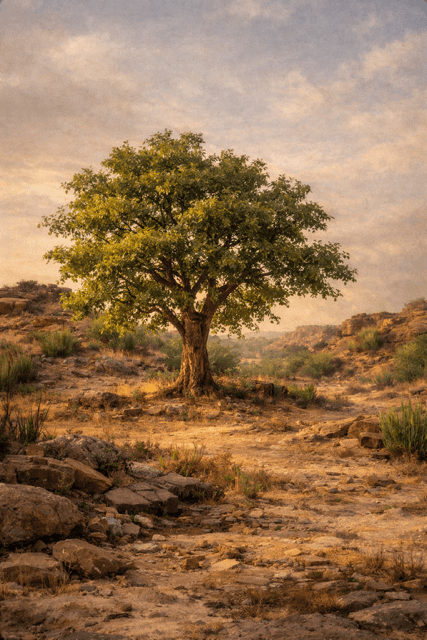
In the late afternoon of our second day in Jodhpur, we proceeded by car in the direction where he remembered this grove to be located. Traveling on any road in India is always an adventure because one never quite knows what is going to happen. Since there are no reliable road signs, one must constantly ask for directions from people traveling by the wayside. This experience offers a totally unique way to relate to the region through which one is passing. The local people are often very kind and, in most cases, possess tremendous knowledge of their locale.
After traveling perhaps five miles, we came upon a dignified elderly farmer walking slowly along the roadside. We asked him if he knew of any place where Kadam trees grew. He replied in the affirmative and told us that he would happily guide us to the exact location. So we invited him into the car, and from that point onward he became our trusted guide.
At one place he instructed the driver to leave the paved road and turn onto a narrow dirt track. On our own, we never would have been able to locate the place we sought. As we followed this winding path, the landscape gradually changed. We entered a rocky ravine until we came upon a small temple standing quietly in the middle of nowhere. No one was about, and there was a wonderful stillness and serenity in that timeless environment.
Sita's Pond
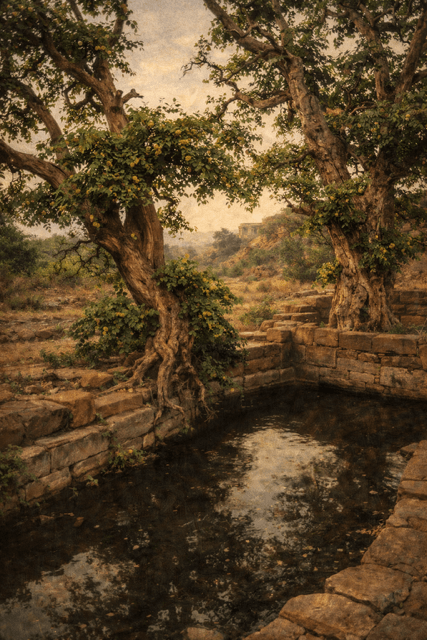
The farmer then led us to a small natural pond surrounded by very old and gnarled Kadam trees which, at this time of year, bore many deliciously fragrant blossoms. It was an exceedingly charming scene. The old temple, the venerable Kadam trees, the clear pond reflecting the sky, the rocky ravine encircling us, and the company of Ramakant and this gentle elderly farmer created a gladness in my heart that is difficult to describe. It truly seemed to me that we had stepped into another world — a world where only innocence and purity prevailed.
Only one difficulty presented itself to us, and that was that most of the Kadam flowers were beyond our reach. I had caught a faint whiff of their heady fragrance, but I longed to inhale a full, mingled draught from several blossoms gathered together.
The Children in the Branches
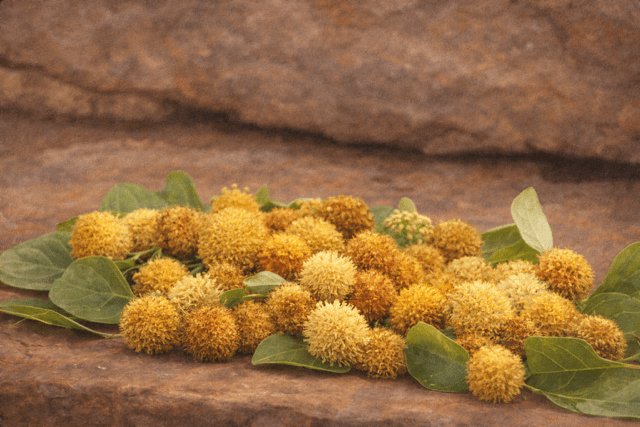
Just at that very moment, a whole group of young children appeared, laughing and chattering like a flock of bright little birds. Anyone who has traveled in the interior of India and looked into the faces of these pure souls knows what sparkle and joy radiate from them. Having little in the way of worldly possessions to burden them, they draw infinite inspiration from their natural surroundings. They approach strangers with a trust and openness that melts the heart.
At our simple request to pluck a few flowers from the higher branches, they were off and up the tree in an instant. I marveled at their effortless agility. There must have been ten children ornamenting the tree, their glowing smiles and twinkling eyes shining among the golden blossoms. Soon they had gathered a small bundle of flowers for us and came down from the branches as easily and lightly as they had ascended.
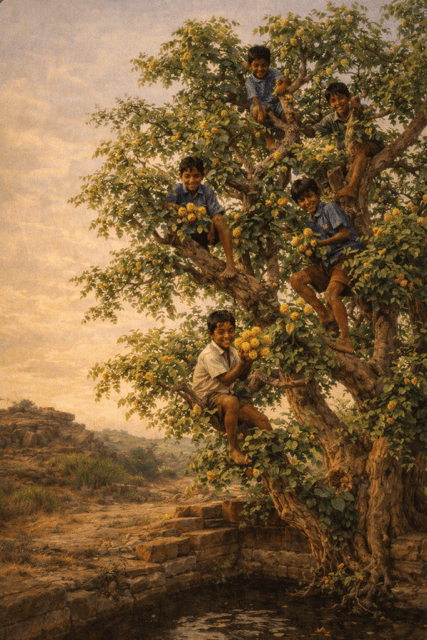
For the next hour we all enjoyed one another’s company as the gracious evening descended upon us. From the surrounding hills a number of peacocks slowly emerged, their calls echoing across the ravine and further accenting the beauty of the scene. The air grew cool and sweet as we sat upon the temple threshold. The old farmer then began to relate the story of how this sacred place came into being.
The Story of the Renunciate
He told us that many hundreds of years ago a great renunciate had come to this ravine and seated himself there in deep meditation. For years he remained absorbed, unmoving in his devotion, and through the power of that sustained spiritual practice a grove of Kadam trees is said to have spontaneously sprung up around him. The noble form of the once-towering trees, and the sweet fragrance exhaled by their golden blossoms, were believed to have been granted as a gift from the unseen Power — a gentle offering to make his retreat more restful and serene.
It was also said that, because of his great devotion, Lord Rama and his wife Sita visited him on their journey back to Ayodhya after her rescue from captivity. The small pond came to be known among the local people as Sita’s Pond in honor of the belief that she bathed there. According to the farmer, that pond remained full even in the years of the severest drought, as if quietly sustained by grace.
India's True Treasure
Parting with the dear village children, we began our return journey to Jodhpur. Once we reached the main road, the gentle farmer who had so kindly shown us the way to the Kadam grove took his leave. When we speak of the wealth of any country, we often think in terms of material abundance, but I believe that such people are India’s true national treasures. They embody simplicity, kindness, humility, and courtesy — qualities that are the real adornments of life.
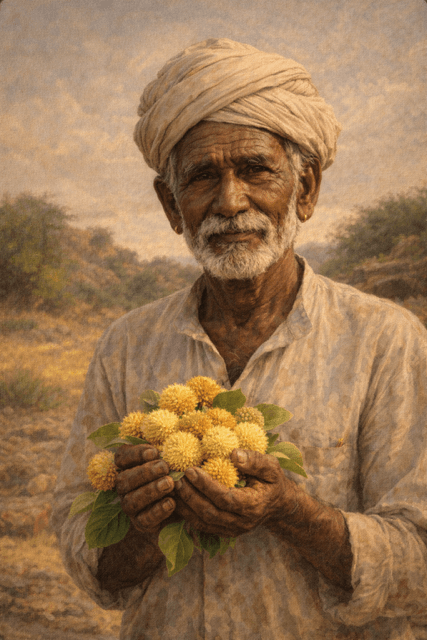
The beauty of that afternoon, with its rich blending of landscape, people, plants, animals, and climate, remains etched in my memory as one of the finest experiences of my life.
Krishna and the Kadamba
The Kadam tree is often depicted in traditional paintings of Lord Krishna surrounded by the Gopis (milkmaids). He is frequently shown engaged in dances and playful divine pastimes beneath its spreading branches, the golden globes of its blossoms glowing softly above the scene. Because of their round, luminous form, these flowers are affectionately known as Krishna laddus. (Laddus are a beloved Indian sweet, golden in color and spherical in shape.) Numerous celebrated depictions portray Krishna hiding within the Kadamba tree after playfully stealing the garments of the Gopis while they bathed in the river — a symbolic episode rich with devotional meaning.
Because the tree plays such a prominent role in this sacred allegorical drama — one that expresses the tender, intimate, and playful relationship between the Supreme and the soul that longs to unite with it — the Kadam tree and its flowers have become dear to hearts throughout the length and breadth of India. In Mathura, the city most intimately associated with Lord Krishna, magnificent specimens may still be found growing within temple precincts. During the flowering season, garlands woven from these exquisite blossoms are offered in temples and placed around the necks of holy personages in loving remembrance of Krishna and his sportive pastimes with the Gopis.
Kaliya Naga and the Enduring Tree
In another important story, the Kadam tree appears as the lone inhabitant of an island in a lake where a giant many-headed serpent dwelt. This serpent, known as Kaliya Naga, was said to possess such venomous breath that it destroyed any creature who ventured within several miles of its presence. The air around the lake had become so poisoned that no life could flourish there.
Yet the Kadam tree alone endured.
It was believed that the tree had received the power to withstand the serpent’s deadly breath because, on a distant occasion, Garuda — the radiant eagle of Hindu mythology — had rested upon its branches. Garuda had been returning from the heavenly realms carrying the pot of nectar that grants immortality to those who partake of it. As he paused in the tree, a drop of that celestial nectar fell upon its trunk and roots, conferring upon it an enduring vitality. Thus the Kadam tree stood unharmed in a place where nothing else could survive.
Krishna also enters this story when he comes to the lake and confronts the serpent. In a fierce encounter he subdues the many-headed Kaliya, dancing upon his hoods and ultimately restoring purity to the waters. The tree remains as silent witness to this divine drama.
These stories are deeply symbolic, and every image within them carries a resonance that speaks to the Indian heart. The serpent may represent the poisonous tendencies of ego and ignorance; the lake, the troubled mind; and the Kadam tree — with its luxuriant foliage, noble stature, and golden blossoms exuding a fragrance like aromatic nectar — may suggest how beauty, grace, and spiritual vitality can endure even in the most corrupted surroundings. A single drop of divine nectar is enough to preserve life in the midst of decay.
The Sacred Mountains
In Plant Myths and Traditions in India, the Kadamba tree is also mentioned as a denizen of one of the four sacred mountains of Indian cosmology:
“In the Vishnu Purana there is mention of four sacred mountains: Mandara, Gandhamandana, Vipula, and Suparsva, and upon each of them grows a great tree — Kadamba, Jambu, Aswattha, and Vata — each spreading over 1,100 yojanas (a yojana being approximately 7.2 kilometers) and towering like banners. In the Bhagavata Purana, a mango tree grows upon Mount Mandara; Jambu upon Merumandara; Vata upon Kumuda; and Kadamba upon Suparsva. The original Kadamba tree grows upon Gomantha Mountain, one of the sacred mythic peaks of Hindu tradition…”
Ancient Wisdom and the Natural World
One may or may not feel especially drawn to explore the rich symbolic universe of the Indian mind, yet on another, more practical level, one can discern a simple and enduring wisdom behind these stories. As in many ancient cultures, the sages and seers who guided the moral and spiritual life of the people were also deeply concerned with preserving the natural world. They understood that the balance of nature is delicate and that human beings must live in conscious relationship with the environment that sustains them.
The ancient epics are replete with accounts of plants — their origins, their spiritual associations, and their material properties. These narratives are not merely decorative myth; they often serve as subtle instruction. By weaving plants into allegorical dramas and sacred histories, the storytellers may well have been encouraging careful observation of the world around them. It was taught that plants are living presences and that they must be honored and respected if their gifts are to be rightly received and wisely used for the welfare of humans and non-humans alike.
The discipline of close observation was essential to survival — agriculturally, medically, and spiritually. It is therefore quite possible that beneath the richly symbolic surface of these stories lies a practical teaching: learn to see, learn to listen, and learn to live in harmony with the subtle rhythms of the natural world.
The Art of Kadam Attar
Kadam flowers provide the raw material for producing Kadam Attar, a traditional Indian perfume created by placing freshly gathered blossoms into a water-filled copper vessel and distilling their aromatic essence into a receiver containing pure sandalwood oil. The fragrance of the flowers is thus gradually absorbed into the sandalwood through repeated hydro-distillation.
If one were to attempt producing a pure hydro-distilled essential oil — as is done with Rosa damascena, Pandanus odoratissimus, and Jasminum sambac in the traditional process that yields oils known as “Ruh” — the resulting quantity would be so minute as to render the oil virtually unattainable. The estimated yield of such a pure Kadam oil is approximately 0.008%. In practical terms, this means that nearly 12,500 kilos of flowers would be required to produce a single kilo of essential oil.
By contrast, to create a deeply fragrant Kadam attar, the process becomes more realistic, though still labor-intensive. Approximately 80 kilos of fresh flowers are distilled each day into sandalwood oil over a period of about fifteen days. (The distillation period may be extended if an extra-strength attar is desired.) Over the course of those fifteen days, roughly 750 kilos of flowers will have been distilled — a considerable quantity in itself, yet still vastly less than what would be required to produce a true Ruh.
On casual observation, one might reasonably wonder how a comparatively modest quantity of flowers can yield a truly potent attar. Several important factors account for this.
Each day, a fresh charge of blossoms is distilled for eight to ten hours under low pressure and relatively gentle heat. The steam-borne aromatic molecules travel from the copper cauldron through a bamboo conduit and pass directly into the slightly warmed sandalwood oil held within the receiver. Sandalwood possesses a remarkable absorptive character; it not only captures the heavier aromatic fractions but is also capable of retaining many of the more delicate molecules that might otherwise remain suspended in the distillation water.
After the day’s distillation is complete, the mixture is allowed to cool overnight so that the oil and water separate fully. The fragrant water is then carefully decanted and returned to the still for the next day’s charge, along with whatever additional fresh water is required. In this way, the process becomes cumulative. Subtle aromatic traces are not discarded but gradually built up over successive distillations, deepening and enriching the sandalwood base.
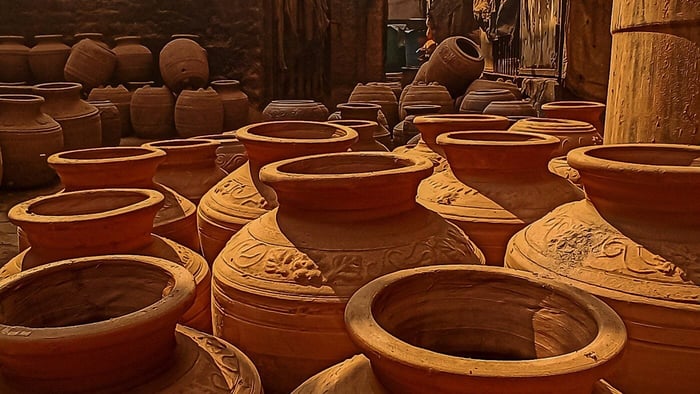
A standard copper deg generally accommodates approximately 45–60 kilos of flowers, together with sufficient water to allow the material to float freely. Over the course of fifteen days, the repeated infusion of fresh blossoms into the same sandalwood base creates an attar of considerable depth and persistence. This, in simplified form, is the essence of traditional attar preparation.
The resulting oil exhibits characteristics such as those described by Stephen Arctander:
“Anthocephalus cadamba oil is a pale yellow or yellow oily liquid of a woody-floral and sweet odor with a short-lived but strong minty-borneolic top note. The dryout is delightfully sweet-floral, reminiscent of champaca and neroli. The tenacity of the fragrance is almost incredible.”Regarding this tenacity, we made an observation that quietly confirmed Arctander’s description. When we left the ravine, we carried with us a small bundle of Kadam flowers wrapped in a handkerchief, which we kept lightly moistened. During the following week of our travels through Rajasthan, the blossoms continued to exhale their exquisite perfume. Whenever we left a room and later returned, we were greeted again by their fragrance, as though the flowers had only just been gathered. It was especially pronounced in the early morning hours, when the air was cool and still.
GCMS Analysis of the Oil
When a gas chromatographic (GC) analysis was conducted on pure Kadam flower oil, it revealed the presence of the following constituents:
“The oil contains linalool, 20.4%; geraniol, 10.6%; geranyl acetate, 9.6%; linalyl acetate, 9.5%; alpha-selinene, 8.4%; 2-nonanol, 7.0%; beta-phellandrene, 3.2%; alpha-bergamottin, 3.2%; para-cymene, 2.96%; curcumene, 2.3%; terpinolene, 0.99%; camphene, 0.9%; myrcene, 0.4%; and unidentified compounds, 20.7%.” (Wealth of India, Volume 1, page 307.)It should be noted that this analysis represents a single sample of oil produced at a specific time and in a particular region. Essential oils are living expressions of climate, soil, rainfall, harvest conditions, and distillation technique. For this reason, one can expect considerable variation in the relative percentages of these components depending upon seasonal and geographical factors. No two distillations are ever precisely identical, and it is this natural variability that gives traditional flower oils their subtle individuality.
Therapeutic Properties
Naturally, the question arises as to what therapeutic properties this oil may possess. At present, however, it is not possible to assign it specific clinical applications with certainty. Such research requires substantial funding, controlled study, and institutional support — resources generally available only to major research bodies. Perhaps in time, more systematic investigation into traditional attars of this kind will be undertaken.
Yet it would be unfortunate to overlook the intrinsic virtue of a beautifully prepared attar. Its fragrance is not dependent upon laboratory validation in order to offer value. When one takes the time to learn about the plants from which such oils are distilled — to understand their habitat, cultural associations, traditional preparation, and aromatic character — one has already entered into a subtle form of self-education that is quietly restorative.
To turn one’s attention toward nature and her intricate creations is to step, even briefly, outside the habitual currents of daily life. The mind becomes clearer. The imagination awakens. A shift in perspective often follows. Sometimes this alone is enough to bring balance to thought and feeling. And when one inhales a refined natural aroma with awareness and patience, there may arise a gentle sense of alignment — a reminder of a more integrated and wholesome way of being.
The Kadam Garland
A Circle of Golden Fragrance
There is something deeply intimate about a garland.
A tree may tower above us in majesty.
A blossom may intoxicate us with its perfume.
But when flowers are gathered and threaded together into a circle, they pass from landscape into relationship.
The Kadam flower, with its golden spherical form, seems almost destined for this purpose. Each blossom is complete in itself — a small globe composed of hundreds of tiny tubular florets radiating outward in perfect geometry. Yet when several are strung together, their beauty multiplies rather than diminishes. They do not lose individuality; they enter harmony.
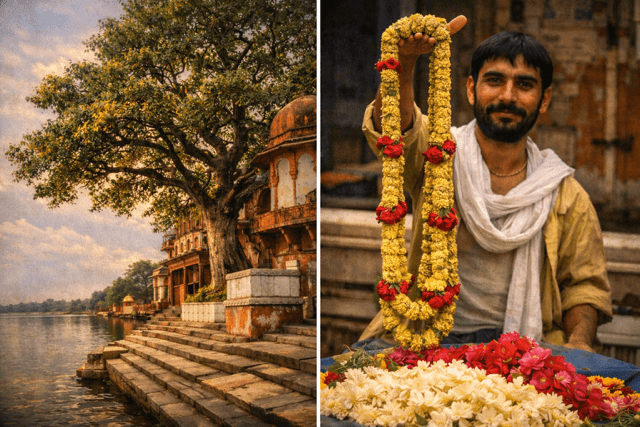
In North India, during the flowering season, garlands of Kadam may be found in temple precincts, particularly in regions associated with Krishna. The blossoms — sometimes called Krishna laddus because of their round, sweet-like form — are gathered at dawn when their fragrance is most alive. The scent is soft yet penetrating, sweet yet green, with a cooling undertone that lingers in the air long after the garland has been lifted.
To offer a Kadam garland is to participate in a gesture older than memory.
In the devotional imagination of India, Krishna is often depicted beneath the Kadamba tree, playing his flute among the gopis. The garland becomes an extension of that symbolism — a circle of devotion placed around the neck of the Beloved, or around the image of the Divine in a temple. The act is simple: flowers gathered, threaded, offered. Yet within that simplicity lies a profound theology of love.
A garland has no beginning and no end. It is a circle.
Perhaps this is why it so perfectly expresses the relationship between the human heart and the unseen Power it seeks. The devotee offers fragrance; the Divine returns grace. The exchange is continuous, like the turning of seasons or the return of the monsoon.
There is also something wonderfully practical and human about the garland. The flowers are ephemeral. By evening they begin to fade. Their fragrance softens. Their petals loosen. Yet this very transience deepens their meaning. The offering is not made because it will endure, but because it is beautiful in the present moment.
In this way the Kadam garland teaches a quiet lesson.
Beauty need not be permanent to be sacred.
Fragrance need not be bottled to be meaningful.
A blossom need not be distilled into oil to carry power.Sometimes it is enough that it was gathered with care, threaded with attention, and placed with reverence.
When one holds a Kadam garland in the hands — feeling the cool firmness of the blossoms, inhaling their subtle sweetness — one senses that the tree has come closer. The ravine, the monsoon sky, the peacocks, the children climbing among the branches — all are contained, in miniature, within that fragrant circle.
The grove becomes wearable.
And perhaps this is the deepest mystery of the Kadam:
that what once towered above us can be gently lifted and placed upon the heart.