
Table of Contents
Vetiver blinds, that lend
To burning summer noons
The scented chill
Of winter nights.
— Bihari (1595–1664)
In Quest of Wild Vetiver
In February of 1995, I had the opportunity to travel with my fragrance mentor, Ramakant Harlalka, and his good friend Dr. Maheshwari to the north Indian town of Kannauj, in the state of Uttar Pradesh.
Our purpose was not casual travel.
We had come to explore the traditional perfume industry that, even in that modern decade, continued to thrive quietly in that historic center of distillation.
Kannauj is not merely a town.
It is a repository.
For centuries, copper stills have been heated there. Clay has sealed their rims. Bamboo pipes have carried aromatic vapor from deg to bhapka. Roots, flowers, woods, and resins have surrendered their hidden essences into waiting sandalwood oil.
At that particular time of year, one of the principal materials being distilled was wild vetiver root — known locally as khus.
During the few days I spent in their company, I began to understand not only the technical process of distilling this humble root, but also the deeper importance it has held in Indian life across centuries.
For vetiver is not merely an oil.
It is relief.
It is earth made fragrant.
It is cooling breath in a land of relentless summer.
Ruh Khus

$11.25
Ruh khus means "soul of khus" — and khus is what India calls vetiver. This is not the tidy, linear vetiver most Western perfumers know from Haiti or Madagascar. This is the wild oil, distilled from roots dug out of… read more
Habitat of Wild Vetiver
This remarkable grass, whose underground structure consists of a dense system of fine, spongy, fibrous roots, grows wild throughout much of North India — particularly in the states of Rajasthan, Uttar Pradesh, Haryana, and Madhya Pradesh.
Botanists often refer to it as the "seedy" vetiver, for unlike the cultivated variety, it propagates through seed. The cultivated type — known technically as Vetiveria zizanioides (now more commonly classified as Chrysopogon zizanioides) — must be propagated by division. It does not reproduce true by seed and is therefore controlled and managed through human cultivation.
Perfumers, aromatherapists, and students of fragrance throughout much of the world are familiar primarily with the oil of the cultivated variety. This plant is grown extensively in regions such as Haiti, Réunion Island, Java, and South India. Its oil is widely used in perfumery wherever deep, earthy, mysterious, and grounding notes are required.
The wild vetiver of North India, however, seldom enters international commercial channels. It is almost entirely consumed within India itself, where it enjoys remarkable popularity.
The Indian affection for wild vetiver — or khus, as it is commonly called — is such that it commands a price nearly four times that of the cultivated variety.
To an untrained or casual nose, the oils of cultivated and wild vetiver may appear similar. Both are earthy. Both are root-like. Both carry depth and weight.
But to the Indian nose, the distinction is unmistakable.
The attachment to khus oil, even at a sharply higher price, speaks not merely to preference but to recognition. There is a nuance in wild vetiver — a particular tonal character — that resonates deeply within the Indian aromatic sensibility.
Dr. Maheshwari and the Science of Khus
As we continued along the road toward Kannauj, my companions pointed out natural stands of vetiver growing near canals and in open stretches of land.
From a distance, it appeared as nothing more than a tall, wiry, somewhat coarse grass. It stood upright and resilient, adapting itself to varied environmental conditions. Though it prefers rich marshy soil and a warm, damp climate, it is capable of surviving in far less ideal settings.
Visually, there was nothing to distinguish it as the source of one of the most exotic and complex aromas imaginable — a scent that has captivated human imagination for centuries.
This contrast fascinated me.
From a plant so ordinary in appearance could arise a fragrance so extraordinary in character.
I felt fortunate to be in the company of two men who could help illuminate this paradox.
Dr. Maheshwari had devoted a significant portion of his research career to the study of vetiver — both in the field and in the laboratory. He traveled extensively throughout northern India, collecting specimens from wild habitats. These were later distilled and analyzed using modern scientific methods.
In his investigations, he discovered that wild North Indian vetiver could not be easily categorized into a single stable profile. It exhibited remarkable variability in both chemical composition and olfactory character.
He described to us an unusual finding from Rajasthan. While collecting specimens along the same lake, he encountered oils that displayed differing optical characteristics — some exhibiting polar negative rotation, others polar positive.
Optical rotation, determined through instruments such as a refractometer, provides insight into the chiral nature of molecules within an essential oil. (For a fuller explanation of this phenomenon, one may consult David Williams' The Chemistry of Essential Oils.) Such variation within specimens growing in close proximity was highly unusual.
Moreover, he identified wild populations with markedly distinct aromatic personalities — oils that differed perceptibly in scent and measurably in composition.
Recognizing the importance of this diversity, efforts were underway at an experimental agricultural station to cultivate and propagate select wild varieties so that their unique characteristics might be preserved and studied more systematically.
Insights from The Wealth of India
My understanding deepened further through consultation of the section on Vetiveria zizanioides in the encyclopedic multi-volume reference work The Wealth of India.
Several observations stood out:
Studies of oils from various producing regions — including cultivated populations in Kerala and Tamil Nadu — indicate that most varieties are chemically similar, with the notable exception of the North Indian Khus oil.
The laevorotatory North Indian Khus oil is unique in containing both cadinane and eudesmane sesquiterpenes in unusual antipodal configurations. These include khusol, khusinol, and khusitone.
A distinguishing feature of this oil is the presence of significant amounts of laevorotary khusilal — a rare C-14 class terpenoid. This compound is largely responsible for the strong laevorotation of North Indian Khus oil and is absent in the typical dextrorotary oils produced in Haiti, Réunion, Java, and South India.
In addition to aromatic compounds, roots from North India have been found to contain fructose, glucose, sucrose, and notably free glycerol — marking one of the first reported occurrences of free glycerol in plant tissue, a finding of considerable biological interest.
The Challenge of Complexity
Ramakant added that beyond its regional uniqueness, vetiver in general presents research scientists with extraordinary challenges.
It is among the most chemically complex essential oils known.
Modern analytical methods have identified more than 150 aromatic molecules within vetiver oil, yet certain constituents remain elusive — present, perceptible, but not fully characterized.
On the international ISO board for essential oils — upon which Ramakant serves alongside some of the world's leading researchers — vetiver is a perennial subject of fascination. Its chemical intricacy defies easy standardization.
He suggested, half scientifically and half poetically, that perhaps the oil's extraordinary complexity arises from the structure of the root system itself.
Vetiver does not send down a single dominant taproot. It develops hundreds — even thousands — of fine rootlets, each in direct contact with the surrounding soil. Through this vast subterranean network, the plant draws in minerals and subtle compounds from the earth, transforming them within its vascular system into a galaxy of aromatic molecules.
Whether viewed through the lens of chemistry or contemplation, one cannot help but marvel.
Plants draw from soil and water an astonishing abundance of aromatic compounds — in combinations so varied and refined that human science continues to chase their understanding.
When we consider how a simple grass can transmute earth into fragrance of such depth and nuance, we are compelled to acknowledge that we are participating in something profoundly mysterious.
In the case of vetiver, that mystery lies not in the flower, but in the root.
The Distilleries of Kannauj
Attar Production
Upon reaching Kannauj, we began visiting both old and new perfume houses, witnessing a wide range of distillation techniques — some ancient, others incorporating more modern adaptations.
Kannauj sits near the banks of the Ganges River and was the capital of India in the 7th century. Later, during the rule of the Mughal emperors, it became a principal seat of perfume making — a position it has maintained into the present era.
It is difficult to determine precisely when its perfumery tradition began. It may well have preceded its political prominence. The rich and fertile lands along the Ganges would have been ideally suited for cultivating the aromatic plants that have captivated the Indian imagination since early civilization. In earlier centuries, when the Ganges ran wider and deeper, ships could travel its course with relative ease, facilitating the exchange of botanical treasures across regions.
While much of this remains speculative until further historical evidence emerges, what is certain is that Kannauj has maintained an unbroken tradition of perfumery since at least the 16th century.
When we first entered a traditional distillery, I felt as though I had stepped into another era.
Rows of copper stills — degs — were mounted upon earthen ovens, beneath which wood-fueled fires burned steadily. In one of the stills, nearly one hundred pounds of marigold flowers (Tagetes erecta) lay submerged in water.
From the lid of each deg, a bamboo pipe — wrapped tightly in twine made from local grasses — extended outward. These pipes, known as chongas, connected the deg to a long-necked copper receiver called a bhapka, which rested in a cooling water bath slightly below the level of the still.
Within the bhapka lay precious sandalwood oil.
As aromatic vapors rose from the heated flowers in the deg, they traveled through the bamboo conduit and condensed into the sandalwood oil below. This unique process — hydro-distillation of floral vapors into sandalwood — produces what is traditionally known as attar.
The atmosphere surrounding the process was extraordinary.
Fire tended by hand.
Heat regulated by experience.
No thermometers.
No gauges.
The control of temperature rested entirely upon the judgment of seasoned distillers. If the heat rose too high, the water in the deg could evaporate too quickly, scorching the flowers and ruining the fragrance. A single miscalculation could cost thousands of dollars.
Meanwhile, others carefully monitored the receiver. The outer surface of the bhapka was touched repeatedly to gauge its temperature. The water bath surrounding it had to remain cool enough to ensure proper condensation. As soon as the bath grew warm, fresh cool water was added.
These and countless other small adjustments were carried out quietly and methodically.
Nothing was hurried.
Nothing was left unattended.
Production of Ruh Khus
The very same apparatus was used in the production of ruh — a pure hydro-distilled oil.
The crucial difference was this: the receiving vessel contained no sandalwood oil.
Instead of absorbing vapors into a fixative base, the aromatic essence was collected directly from the condensed distillate. The bamboo pipe connecting the deg to the bhapka was often made longer, allowing for greater cooling before condensation.
Thus was produced ruh khus — the pure distilled oil of wild vetiver.
Before being placed into the deg, the harvested roots were chopped using a hand-operated machine. They were then soaked in water for ten to twelve hours. This pre-soaking helped soften the dense root mass and prepared the oil-bearing sacs within the roots to open gradually under gentle heat.
The distillation was initiated slowly.
The traditional deg system cannot operate under high pressure. The seal between the body of the deg and its lid is formed by a thick coil of clay — a "clay snake" — placed entirely around the rim. The lid is forced down onto this clay seal by slipping a hooked metal brace beneath the rim of the still and over the lid, then driving a wooden wedge into the open space above it to create tension.
The bamboo pipe emerging from the lid is secured with twine, and its entry point is sealed using cotton and clay.
It is immediately evident that such a system cannot withstand high-pressure distillation. It was never designed to.
Some believe that this low-pressure, low-heat method preserves delicate aromatic constituents that might otherwise degrade under modern steam distillation conditions.
A typical ruh khus distillation continues for twelve to twenty-four hours — or until the essence is fully extracted from the roots.
When the process concludes, the liquid collected in the receiver is saturated with the fragrance of vetiver. After cooling, the oil separates naturally from the water. The precious oil is gathered by gently passing special brushes across the surface to absorb it. The oil is then squeezed from the brushes into bottles — vessels that hold the concentrated spirit of the root.
This is ruh khus.
No sandalwood intermediary.
No blending.
Only earth transformed through fire and patience.
The Wild Vetiver Harvest
As I sit at my desk writing these lines, I hold in my hand a small bottle of this exquisite essence.
The sample was prepared by our close friend, Mr. Manoj Avasthi — a lifelong resident of Kannauj and a professional perfumer of deep integrity. We had entrusted him with personally supervising the preparation of the finest ruh khus that could be produced.
His work begins in October, when the harvest of wild vetiver roots commences in earnest.
Harvesting cannot begin until the monsoon season has fully passed. The saturated soil must dry sufficiently, and the roots themselves must mature in the ground. Only then can they yield their best oil.
In order to understand the entire process from beginning to end, we requested that Manoj travel to one of the remote areas where the digging was underway.
He journeyed far off the main roads, deep into the interior of Uttar Pradesh, to document this remarkable part of the story.
Many Western readers may find it difficult to imagine that vast regions of India remain uncultivated and open. Yet such landscapes still exist. In these expanses, wild vetiver grows in great swaths — acres upon acres of tall grass whose treasure lies hidden beneath the soil.
The harvesters are members of what Indians call the Adivasi — tribal communities regarded as among the original inhabitants of the land.
During harvest season, they camp near the vetiver fields for several months. Temporary huts are constructed from readily available materials, including the above-ground stalks of vetiver itself, which serve as thatch. Small hearths are dug into the earth for cooking simple meals in metal vessels.
When the day begins, they take up handmade tools for prying the roots from the soil.
Before the roots are removed, the aerial portion of the plant is cut back, leaving approximately 15–20 centimetres above ground. These stalks are not discarded; they are gathered and later used for various purposes, including the construction of elaborate temporary structures for religious ceremonies.
The principal harvesting implement is a stout, long-handled pry bar. It is driven deep into the earth and levered upward to loosen the dense root mass. In some cases, heavy steel-pronged forks are also used.
When a clump is lifted, only about sixty percent of the root mass may come free. The harvesters often re-dig the area to recover as many remaining rootlets as possible.
Soil is knocked away from the roots by striking them against stones or wooden blocks. Women then sit together, trimming away the remaining aerial portions with machetes, leaving just enough stem attached to hold the root ball intact.
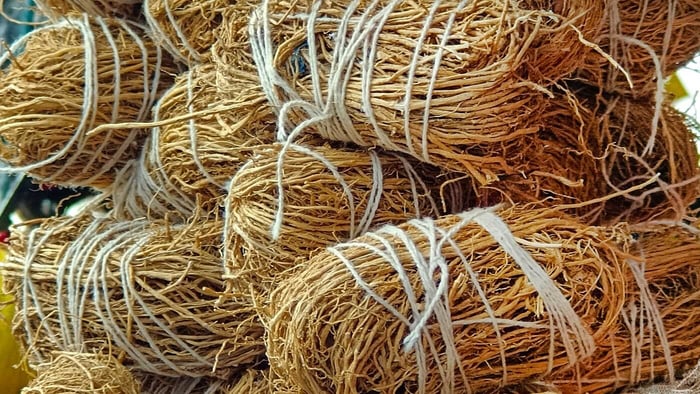
The roots are then tied into neat bundles.
It is truly an art to watch how deftly this is done — each bundle uniform, balanced, and beautiful in its own quiet way.
Smaller bundles are gathered into larger units and secured to both ends of a carrying pole. These are lifted onto the shoulders of men and transported to a central collection area.
After several weeks of digging and bundling, a substantial stock of vetiver accumulates.
Buyers then travel to these remote camps to purchase the harvest. The bundles are carefully counted and weighed before being loaded into bullock carts. From there, they are transported to the nearest paved road, where trucks await to carry them onward to Kannauj.
Upon arrival, the roots are delivered to various distilleries. Some will produce ruh khus through the traditional deg method. Others will employ modern steam distillation units.
The procurement of roots is one of the most important events in the annual calendar of Kannauj's distillers.
Those who use traditional deg apparatus are often extremely selective. Because their stills are smaller, they can dedicate individual batches to roots from a specific district. Among the city's perfumers, it is well known which regions produce roots with particular aromatic nuances.
True connoisseurs can even discern whether roots have been harvested at the proper maturity. Roots aged between eighteen and twenty-four months are considered optimal for oil quality.
The art of selection is subtle and well understood by those who produce oils for discerning buyers. High-end contracts often specify roots from certain districts and harvested at specific ages. In such cases, the deg method is almost always preferred.
By contrast, larger steam distillation units may charge five hundred to one thousand pounds of material at a time. In doing so, they frequently combine roots from multiple regions and varying stages of maturity.
The differences between deg-distilled khus and steam-distilled oil may be fine — perhaps even difficult to quantify analytically — yet there is little doubt that the former carries an old-world resonance.
Whether that resonance can be measured scientifically is another matter.
But one senses it.
The deg method is labor-intensive, intimate, and rooted in generations of craft. It embodies a human scale of production that I sincerely hope can be preserved.
Olfactory Character of the Oil
Now, as I evaluate the oil in my hand.
It is dark — thick — brown — almost syrup-like in consistency. A properly distilled oil deepens with time. As it matures, its viscosity increases and its aroma grows more profound and concentrated.
The immediate impression is one of powerful earthy diffusion.
This is not a light fragrance.
It possesses weight.
If used as a perfume in its own right, it may stand alone beautifully. But if incorporated into a blend, it must be diluted thoughtfully, lest it dominate the entire composition.
Images arise readily:
Freshly turned soil.
Roots pulled from damp ground.
Forest floors after rain.
Yet within this robust earthiness lies something unexpected — a quiet, almost hidden sweetness. It does not sit atop the earth notes; it is interwoven among them, like fine threads of warmth within dark fabric.
As one descends further into its layered structure, precious wood nuances begin to emerge — subtle tonalities reminiscent of sandalwood and even agarwood. These are not identical, but they occupy a similar register of depth and refinement.
Vetiver is not merely earthy.
It is architectural.
Fixative Power and Creative Use
The tenacity of this oil is widely respected.
It is a fixative par excellence — capable of binding together the most volatile top notes and the deepest base notes within a composition. It acts as a bridge between the ephemeral and the enduring.
In the hands of a skilled perfumer, it can yield remarkable results in fougère, chypre, and oriental compositions. It lends gravitas and structure where needed.
Yet one must approach it with discernment.
Vetiver prefers the front seat.
Unlike sandalwood, which can retreat gracefully into the background and offer quiet support, vetiver tends toward dominance. If used carelessly, it can obscure rather than enhance.
Measured restraint is essential if other notes are to remain clear and distinct.
Among the oils with which it blends harmoniously are patchouli, cinnamon bark, linaloe berry, sandalwood, oakmoss, opopanax, and mimosa.
Each pairing reveals a different facet of its personality.
For those inclined toward creative perfumery, vetiver offers vast exploratory potential. It rewards patience. It demands attention. It brings solidity and cohesion to a blend when used with understanding.
Indigenous Uses of Vetiver
The oil of vetiver is not confined to perfumery.
Since antiquity it has occupied an honoured place in indigenous systems of medicine. Perhaps its most widely recognized property is its refrigerant effect.
During the intense heat of the Indian summer, a few drops of the oil are added to bath water or applied directly to the skin to mitigate the effects of external heat. It has also been used traditionally in the treatment of flatulence, colic, and persistent vomiting. Applied locally, it is said to bring relief in cases of sprain, rheumatism, and lumbago.
The hydrosol — the fragrant water remaining after distillation — enjoys a life of its own. It is widely used in preparing a cooling sherbet, a cherished summer beverage that quenches thirst and lowers body temperature. This same aromatic water finds its way into regional cuisines, particularly sweets, lending a subtle earthy freshness to confections and drinks alike.
The Root in Domestic Life
The dried roots themselves are woven deeply into household life.
Indian homemakers often layer them among stored clothing, both to repel insects and to impart their distinctive fragrance to the fabric. In South India, the roots are woven into sleeping mats, which provide a natural cooling effect during oppressive nights.
Perhaps the most renowned domestic use of vetiver is in the making of window screens — khus chiks — which have been used for centuries as a natural form of air conditioning.
During the hot months, these woven screens are hung over windows and periodically sprinkled with water. When even the slightest breeze passes through the dampened roots, the air is cooled and gently perfumed. The effect is both practical and sensual — relief from heat accompanied by fragrance.
This cottage industry remains alive in North India.
Nathdwara and Sacred Cooling
In the sacred city of Nathdwara in Rajasthan — home to the ancient temple of Shri Nath Ji — the use of khus mats assumes ceremonial grandeur.
The temple complex is sealed with thick mats of fragrant reed during the summer months, shielding the interior from the scorching sun and drifting dust. To maintain their cooling potency, attendants continually sprinkle the mats with water. As the dampened roots release their sweet, earthy fragrance, manually operated ceiling fans circulate the perfumed air through the inner chambers.
Hand-held fans, some fashioned from khus itself, are also used within the sanctum. Imitation pavilions made of colored vetiver roots are erected to delight and cool the deity. Even culinary offerings reflect this seasonal logic; khus sherbets remain beloved both by devotees and symbolically by the Lord Himself.
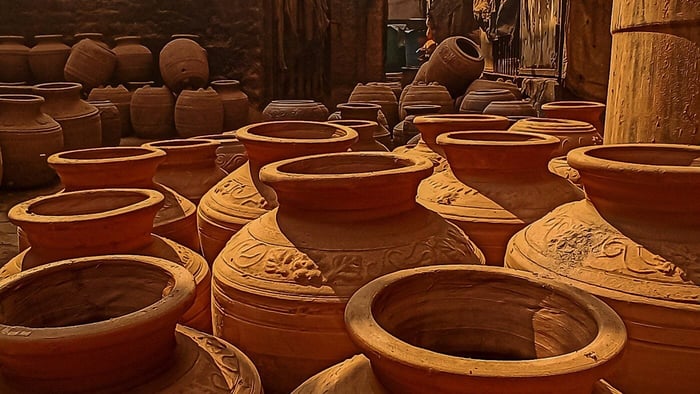
When we visited Nathdwara in July of 1995, I saw exquisite miniature khus pavilions sold to pilgrims. These allowed worshippers to recreate, in their homes, the cooling and fragrant atmosphere of the temple. We were also shown clay water pots wrapped in vetiver roots. As water cooled within the porous clay and slowly evaporated, the damp roots absorbed moisture and released their subtle perfume into the surrounding air.
It was air conditioning, devotion, and fragrance united.
Oil of Tranquility
The rich, mysterious fragrance of vetiver — often called in the East the "aroma of tranquility" — is a profound gift from the botanical kingdom.
Its aesthetic and therapeutic virtues have been appreciated for thousands of years and will, one hopes, continue to offer relief and quiet pleasure for generations to come.
Its story is not isolated.
It is interwoven with the lives of harvesters who pry roots from stubborn earth; with Adivasi families who camp beneath open skies; with distillers who tend wood fires in Kannauj; with perfumers who study its complexity; with householders who hang cooling screens; with temple servants who sprinkle sacred mats; and with all who seek refuge from heat — whether physical or emotional.
When we contemplate the beauty of such an oil, our appreciation deepens if we consciously connect ourselves to the labor that brought each drop into being.
When we reflect upon the long evolutionary processes through which a simple grass, rooted in soil, learned to transmute earth into fragrance, our awareness refines further.
In that moment of recognition, vetiver ceases to be merely an oil.
It becomes earth distilled.
And when its cooling depth touches the senses, one understands why it has long been called the oil of tranquility.